|
| September 3 to 9 |
Valais (in French; "Wallis" in German) is a canton in southern Switzerland. Located in the heart of the Alps, Valais is home to the Matterhorn, upscale ski resorts, and upper Rhône River Valley vineyards. The western half of the canton speaks mainly French, while the eastern half is German-speaking (rather, a dialect known as Swiss German).
SATURDAY: Zurich to Zeneggen
I left Portland at 7pm on Friday on a 10.5-hour overnight flight to Frankfurt. From there, it was a quick jump to Zurich. Switzerland is 9 hours ahead of Portland, so I arrived around 5:30pm on Saturday. My sister Rita, who arrived a few days earlier to experience Zurich, met me at the airport train station. Europe is connected by an efficient train system, so we purchased the 8-day Swiss Travel Pass. We caught up during the scenic two-hour ride south. From Visp, we took a 15-minute taxi ride up the steep, winding mountainside to the tiny village of Zeneggen. Rita and I finally arrived to the hotel around 9pm, where we joined the rest of our family.

After a good night's sleep, I went downstairs to a beautiful spread for breakfast. I cannot say enough about the warm hospitality during our stay at Hotel Alpenblick. The small, family-run bed and breakfast was built in 1935. Smartly renovated, the charming lodge is a cozy home in the center of Valais. Christoph inherited responsibility of the business, and does excellent work in the kitchen and wine cellar. Lending a hand in the dinning room are his mother, Elsbeth, and Bernadette--an intriguing woman from Germany.


Afterwards, we migrated up the street to the hotel for refreshments on the patio. It was exciting and overwhelming to make the rounds and meet everyone; it had been over 20 years since I had last seen most of them, so introductions were in order. My mom brought copies of the family tree, which was a big hit.


Eventually, lunch was served, and the mingling continued. I was surprised to see the "kids" all grown up, some of them with children of their own now. Most of the younger generation speaks English, but many of the older folks speak Swiss German plus or minus French. My dad speaks the language, but it is strong incentive for me to learn German before the next reunion!
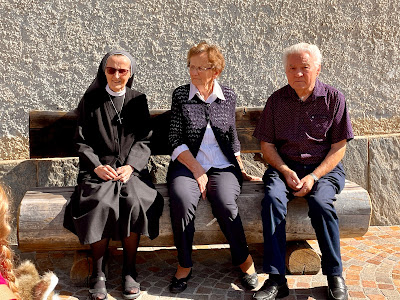
The turnout was a success, with over 100 people in attendance. A big thank you to my dad for organizing it, and to the hotel staff for hosting. Looking forward to the next reunion!


That evening, Andres took us on a walk up to the Kapelle. Zeneggen is truly the quintessential Swiss mountain village. With a population of around 300, it sits high above the Visp Valley, isolated from the hustle and bustle of modern life. In fact, the government incentivizes families to move there in order to keep the schools open.


Carmen joined us for a delicious dinner at the hotel that night. Rösti (pan-fried potatoes) quickly became my favorite local dish.
MONDAY: Moosalp & Törbel
After breakfast, my family and I caught the bus going up to the Moosalp. The high mountain pass across the western Alps connects the villages of Bürchen and Törbel. The Moosalp offers stunning panoramic vistas in all directions and a continual soundtrack of cowbells. Elevation 6,719'.


From there, we hiked mostly downhill to Törbel--another picturesque village with mountain chalets built into the steep mountainside.


We lucked out with weather during the week; rain was forecasted every day, but we had at least partial sun each day, comfortable temperatures, and rain only at night. Like most places, however, the area is in desperate need of rain. We stopped for an afternoon beer before hiking back to Zeneggen, clocking eight miles.

TUESDAY: Sion
Sion ("Sitten" in German) is a 30-minute train ride west of Visp. It is a sun-blessed French-speaking town with terraced vineyards and medieval castles. My great aunt met us at the train station and gave us a tour of the town where she currently lives. She led us through Old Town, past the 15th century cathedral and the Witches' Tower.
Sion ("Sitten" in German) is a 30-minute train ride west of Visp. It is a sun-blessed French-speaking town with terraced vineyards and medieval castles. My great aunt met us at the train station and gave us a tour of the town where she currently lives. She led us through Old Town, past the 15th century cathedral and the Witches' Tower.


Tante Lia has dedicated her life to the Catholic church. She is part of the Sisters of Saint Ursula order in Sion. As such, she became a missionary and helped establish an order in West Africa's Ivory Coast . She is one of my grandfather's last remaining siblings, and a very special person.


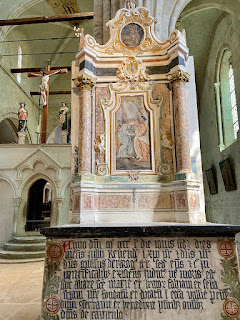
After having lunch at the convent, we walked to the 13th century hilltop castles. The Valère Basilica houses an organ over 500 years old--the world's oldest organ that is still playable. Sitting opposite, Tourbillon Castle was the summer residence of the bishops, and is now a ruin after it was destroy by a fire in 1788. The All Saints Chapel, a small Romanesque-Gothic building from the 14th century, is located between the two hills.




WEDNESDAY: Saas-Fe
Saas-Fe is a 50-minute bus ride south of Visp. The car-free ski resort town is one of four villages in the Saas Valley. Thirteen 4,000 meter peaks surround the glacier village.

My family hiked the Chamois Trail and visited the revolving restaurant, Allalin, while I took on the Almagell High Altitude Trail. This trail above tree line offers sweeping vistas over the Saas Valley and the highest mountains in Switzerland. The hike starts at the Kreuzboden station, which can be reached by cable car from Saas Grund. The trail runs southwards in the direction of Saas-Almagell. The first section is marked as an alpine flower walk.

After crossing the ridge, a beautiful view stretches from the Mattmark Dam to Stalden.


From here, I descended past mountain goats and sheep to the Almagelleralp mountain restaurant. Downstream, the hiking route continues to a junction, where the right-hand path continues to Saas-Almagell.

The trail network is well-marked, but I still found it difficult to navigate at times. The terrain, however, is perfect for trail running; 6.5 miles mostly downhill.

For lunch, I met my family at Arvu Stuba. Saas-Fe would undoubtedly warrant a return visit! Back in Zeneggen, we ate dinner, played cards, and watched the lightning storm from the balcony.
THURSDAY: Diepja
A rest day was needed to break up our otherwise packed schedule. Despite its beauty, it admittedly does get tiresome to drive the endless set of switchbacks from Zeneggen to Visp. Interestingly, our cousin, Christian, is the bus driver in Zeneggen; constantly navigating the tight, hairpin turns behind the wheel of a bus is no small task!
After breakfast, I decided to explore the trails around Zeneggen, which are hilly but ideal for hiking and running in the summer, cross country skiing in the winter. I found my way to the Diepja, which is the summer house of our relatives. The scenery is simply spectacular.


From there, I continued on to Obera Hellela, and finally descended through Alt Zeneggen.


That afternoon, Christoph gave us a tour of the hotel's wine cellar. Grape harvesting had just started, so he was excited to begin making a new batch of wine. Pinot Noir is their main red varietal, which is coincidentally the most common wine grape in Oregon's Willamette Valley.

FRIDAY: Zermatt
Zermatt is an hour south of Visp by train. The mountain resort, which is known for skiing, climbing, and hiking, lies below the iconic, pyramid-shaped Matterhorn peak. Its main street is lined with boutique shops, hotels, and restaurants.

We began our visit with a train ride to Gornergrat. The cogwheel railway starts from the village and ascends to an elevation over 10,000'. The 30-minute journey lends a constant view of the Matterhorn, with a panorama of mountains and glaciers at the top. We hiked down to Riffelberg for photo ops of the area. Apparently, getting a clear shot of the Matterhorn is pretty special; we were relatively lucky with just one stubborn cloud near the summit for most of the day.


Back in the village, we took a cable railway to Sunegga. From there it's a half-mile trek down to Adler Hitta--a nice perch to refuel with a great view.


From Sunegga, we continued up via gondola to Blauherd. I intended to take a short hike to the lake at Stellisee, but decided to scrap it because I was running short on time. Instead, I took the cable car to Rothorn.

I highly recommend a trip to Gornergrat, as well as the series of lifts to Rothorn. However, it would be better to split this over two days in order to allow time to fully enjoy. Plus, it is worth making time to walk through the village.

We returned to Zeneggen that evening to have dinner with our cousins. Andres and Edith had just left for Italy, but their children, Anja, Noah, and Jan, hosted and cooked for us. It was very memorable--and rather adorable--to have these early 20-somethings welcome us into their home.

My initial impression is that Switzerland is something of a utopia; clean, orderly, efficient, and naturally beautiful. I am eager to visit other areas of the country, and to investigate opportunities for expats. Clearly, the wheels are turning to make this my next home!