Eager to escape the gloomy winter rain, I had been looking forward to studying yoga in Nepal in February. As yoga has spread and evolved over the years, "westernized" programs across the world are cranking out new teachers every month. Without discounting this approach, I was seeking a program that honors the traditional yoga origins. Where better to do this than at the source? Despite being well traveled, Asia was unexplored territory for me; I knew that I would be pushed far outside of my comfort zone, but I was ready for a challenge.
 |
| Jan 29 - Feb 27 |
The Republic of Nepal is nestled in between India and Tibet, below the southern slopes of the Great Himalayan Range. Rising to more than 29,000’, these giants can be seen from anywhere in the country. The small nation contains some of the most rugged terrain in the world—roughly 75% is covered by mountains. Religion strongly influences the cultural pride, which colorfully spills into the streets. The vast majority of the 30 million citizens are Hindu, followed by Buddhist. Economically, Nepal is one of the least developed nations in the world, depending heavily on imports and foreign markets. However, its great river systems provide immense potential for hydroelectric development.
The timing of my trip through southern China proved interesting for two reasons: Chinese New Year (Year of the Rat) and the coronavirus. Despite the media frenzy, I did not encounter any issues with my layover in Guangzhou. Still, the 14-hour flight from San Francisco was not a walk in the park. I felt like a zombie walking through the cold airport until a warm sunrise dissolved any looming doubts. After 29 hours of travel (and a 14-hour time change), I caught my first glimpse of the surreal Himalayas just before landing in Katmandu.


I sensed that the disorganized airport foreshadowed what lay ahead. Sure enough, an eye-opening taxi ride through the capital city pushed my senses into overdrive. I was relieved to arrive at what would be home for the next few weeks (see next post). Committed to the yoga teacher training (YTT), my schedule was filled six days a week. During breaks and days off, however, I was excited to get outside and explore. Shar Minub Monastery sits just behind the yoga academy with a great view of Katmandu Valley.


Also nearby is Triten Norbutse Monastery, having close ties to Tibetan Buddhism. February in Katmandu (elevation 4,600’) is considered winter/dry season. It is mostly sunny but chilly, especially in the shade and heavy concrete buildings. Temperatures gradually increased as the month wore on, fluctuating from the mid-60s during the day to around 40°F overnight.


Nagarjun jungle, part of Shivapuri National Park, is easily accessed from the academy. One afternoon, a fellow guest from the USA, Mike, joined me in discovering a steep staircase leading to a Buddhist shrine tucked inside a cave. I returned again later with my group from the program, shocked by the large number of locals that make the grueling trek every morning.


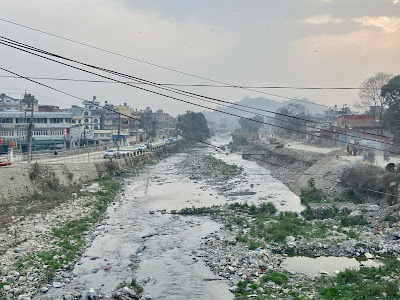
On my first full day off, I joined Mike in central Katmandu. The gateway to the Himalayas has been a backpacker's haven since the 1950s. Still recovering from the 2015 earthquake, it offers a magical mix of chaos and beauty. Without trace of a navigational grid system, traffic is chaotic; cars, buses, motorcycles, bicycles, pedestrians and animals share narrow, rough dirt roads that are covered with electrical power lines (outages are a daily occurrence). This pollution becomes trapped in the valley between the mountains, creating a constant layer of smog, leading many people to wear masks. As a result, the Himalayas can only be seen from Katmandu on rare clear days.


For most visitors, a trip to Nepal begins in Thamel (pronounced "Tah-MEL"). Katmandu's designated tourist quarter is a labyrinth of streets and alleys lined with souvenir shops, hotels, restaurants and bars.


Up until the mid-18th century, Katmandu Valley was split into three kingdoms: Katmandu, Lalitpur and Bhaktapur. Each of these UNESCO World Heritage Sites has a sprawling palace complex, or Durbar Square, which is testament to the country's monarchical past. Katmandu Durbar Square is an intricate mix of temples, palaces, monasteries and shrines that evoke myths and legends passed down through generations.

For most visitors, a trip to Nepal begins in Thamel (pronounced "Tah-MEL"). Katmandu's designated tourist quarter is a labyrinth of streets and alleys lined with souvenir shops, hotels, restaurants and bars.


 |
| Kathesimbhu Shree Gha Stupa |
Swayambhunath or "Monkey Temple" rests on a hilltop with panoramic views of the city. The UNESCO World Heritage Site contains one of the oldest and holiest stupas in Nepal. Statues and shrines of Buddhist and Hindu deities fill the stupa complex, indirectly promoting religious harmony. Buddhist devotees circumambulate the stupa in a clockwise direction.


On my second day off, Samjhana and Erika from the academy joined me in a cultural adventure of two more UNESCO World Heritage Sites. Built in the 14th century, Boudhanath Stupa is decorated with pairs of eyes on each side, representing the all-knowing nature of the Buddha. Soft chanting and burning incense fills the air at this place of worship for Tibetan Buddhists.


Built in the 5th century, Pashupatinath Temple is the largest temple complex in the country. It stretches on both sides of the Bagmati River, where Hindu cremations take place. Hundreds of thousands of devotees from Nepal and India gather here on the festival of Maha Shivaratri. Based on the Hindu lunar calendar, it falls on a night when the stars in the Northern Hemisphere are at optimum positions to increase spiritual energy.


On my final day off, Fabienne from Switzerland joined me on a day trip to Nagarkot. Just 20 miles from Kathmandu, the village is packed with hotels lining a ridge, affording one of the broadest views of the Himalayas. However, timing is everything, as the mountains notoriously disappear behind cloudy skies. Other than views, the town offers very little.

Apart from learning Nepali, I adjusted to several cultural differences during my time abroad:
- Shoes are never worn indoors
- Meals are traditionally eaten without utensils (right hand only)
- Saturday is the holy day
- Slow pace of life despite baseline disorganization
- Poverty is apparent yet contradictions/disparities exist (ie., smart phones)
- Inexpensive cost of living; 1 USD ~ 120 Nepali Rupees ("white privilege")
- Nepalis are friendly but not particularly warm—and communication is different


Local cuisine is a vegetarian’s dream. I especially appreciated the simple and fresh ingredients (nutrient dense vs. processed). Personal gardens are common, and specialized shops replace the supermarket model. Dal bhat tarkari (rice, lentils and mild curried vegetables) is the staple. Less healthy—but equally delicious—street food includes momos (steamed dumplings from Tibet), chatpate (puffed rice/veggie snack) and paratha (stuffed potato bread). Tea is shared at all hours of the day; tap water is unclean for drinking.


A note about the paradoxical treatment of animals—cows are considered sacred; beef is not consumed though cow’s milk is taken. It is a crime to kill a cow (even compassionate euthanasia), so farmers set free baby bulls and spent dairy cows to wander the streets in search of food scraps (usually trash). Stray dogs and cats abound in this same manner.


Due to the growing threat of the coronavirus, my return flight to Portland was rerouted through Qatar and New York for a 33+ hour journey around the world. Upon reflection of my month in Katmandu, I feel immense gratitude for the beautiful connections made and lessons learned. The intense and immersive structure of the YTT compounded with culture shock was overwhelming at times, but conducive to character growth. I look forward to unpacking the experience further in the weeks to come, and witnessing how yoga continues to enhance and transform my life. My biggest curiosity is how to reconcile my new knowledge with the modern methods taught at home. I feel inspired to share my experience with others, and suspect that if I extend the energy outward, the right people will find me. As for my relationship with Nepal, my hope is to return again someday to trek the Himalayas. Until then, Namaste.


